THE FLAMBOYANCE OF NATURE
- Rick Schenk
- Nov 5, 2025
- 36 min read

Miami photographer David Gary Lloyd shares with Ricky the inspiration behind his most recent exhibition, a glimpse into his artistic process, and a devotion to sharing LGBTQIA+ stories.
In this colorful conversation about black and white pictures, the Sunshine State burns bright. Flutter by David's Florida, where there are many flamingos and very few shirts.

"I've always used photography as a means to develop a certain kind of language for myself that I wasn't able to express through words."
RICK SCHENK Tell me your name, how we know each other, and a bit about your artistic output.
DAVID GARY LLOYD A, B, C, so my name is David Gary Lloyd. I am a local Miami artist, and we know each other through Dustin, you reached out to me on Instagram.
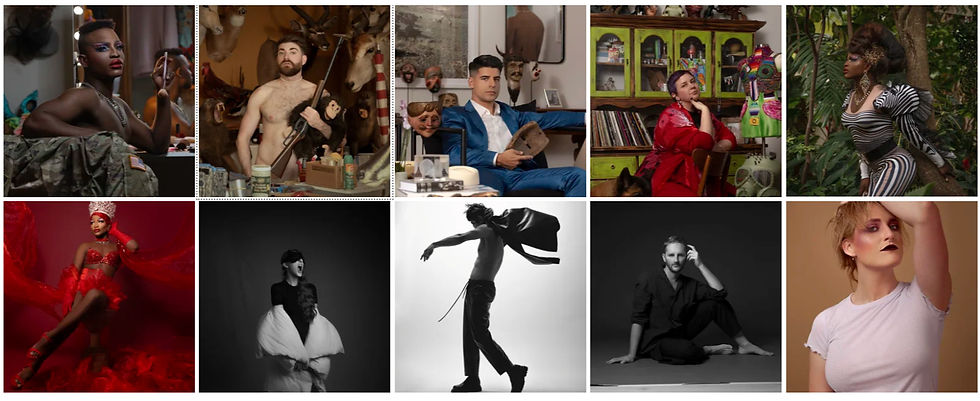
Artistic output. Okay, broad question, I use photography as a communication tool to document and talk about the queer community, specifically in South Florida, but I photograph a lot of different things, nature and places and people. I've always used photography as a means to develop a certain kind of language for myself that I wasn't able to express through words.
RS Do you go out and randomly shoot these natural images? Everything looks so chic. So soigné.
DGL I've never heard soigné. Not very often you get to hear that word soigné
RS I love the word soigné, yeah, and I probably use it too much.
DGL I'm so here for it. It depends, typically I'm more of a contrived photographer, because I use a lot of studio lights, especially in my portraiture. I like to do a little bit of planning before I do a shoot. Sometimes I work with an art director and she helps me put together some fashion choices or art direction. I like to have some conceptual merit that goes into the work that I'm trying to create, because more recently, and especially with my fine art, as opposed to my commercial work which is its own category, I'm trying to develop my point of view as an artist. Conceptual photography that talks about marginalized communities, talking specifically about what I know as a gay man. A lot of my work is pre-planned. I like to think about sets, whether that's location or if I'm doing it in the studio. But sometimes I do get inspired to take my camera out and go shoot nature.
RS If you go to the garden, can you get a great photo with an iphone? As with a fancy camera with specialty lenses as with a point and shoot digital camera? What do you think?
DGL Taking the photo, to be honest, is only half of my process, a lot of the process and maybe where that soigné feel comes in, it's post production like retouching, and doing a lot of work on top of the image. I can hold my own on an iphone camera, I know how to compose an image. I know how to create a focal point. I know how to light an image. A lot of times, someone will be like, hey, can you take my picture? And if I'm with someone that knows I'm a photographer, they always say, “oh, you asked the right person, they're a photographer”…you just want to take the photo for that person and move on with your life. I'm not standing there staging them meticulously and moving them into a certain area, where the lighting is just perfect… Unless it's like, right there. You can take amazing photos with the iphone. It's actually very impressive and incredible. Really, the key is lighting.
"...in nature, there are totally examples of queerness..."

RS I'm looking at your collection, “Garden Shadows of the Sun”, and there's this diptych, of this man on the left, and a butterfly wing on the right. And it's giving the same silhouette. Did that image come to you before you staged it? Or did you take that photo and it looked like a butterfly wing, so you paired it that way?
DGL That's my newest body of work. That was actually not planned so specifically ahead of time. I ended up going through my archives, from the past three years, and starting to arrange photos together. And that for me kind of showed me the stuff I was interested in shooting in general, because it brings together a collection of work. It was fun to play around with the placement of the images and pairing them next to each other to create more narrative than I was getting from just one image. I would go outside and photograph butterflies or flamingos, and then I have all these other portraits that I photographed. It wasn't really until the month before I was to open that show, that I started really having the concept together. I put together a final shoot with like three people with that in mind, but it didn't start off that way. It was experimenting with arranging, just playing around. I think it's fun, I'm sure you know, as a creative person, to be able to step outside of your usual way of making and try to challenge yourself. So that's kind of how that body of work develops.

RS There’s that image that we just spoke about, and then also this very related image of the same model with this negative image of peacock feathers, and it's giving showgirl, which is so strong. You must have been clapping when you put that together. It looks so ‘meant to be’, and cool. I'm noticing that you didn't go crazy.
I do good work when I loosen up my boundaries a little bit, but not too much. Because you're not even cutting images on the diagonal here, they're all squares and rectangles. You're not collaging, you're not ripping paper and laying it over. You're not trying too hard to make the shape match up. Not that there's anything wrong with photo collage, it's amazing, but that's not exactly what this is.
DGL I wanted to do something that felt a little different. I look at a lot of photo shows and photographers. I've been doing this for over 25 years. I think I might have found - I'm trying to even remember which image it was, where I placed them together, and it worked so perfect. And I think it wasn't that showgirl image, because that was one of the last I did actually...

RS Is it his hand with a butterfly and the upside down model?
DGL That one was actually really tough to put together, too, because it just wasn't looking right. It came together really nice, but that went through several iterations before I kind of finally landed on that arm. Look, I had a whole bunch of images out. I was just moving them around and seeing which felt good together. And there's also a little post production where I am manipulating the images a little bit, so they do line up perfectly. The digital painting component comes in with the photographs because I use Photoshop a lot and so for some of the images it was changing the background colors to blend very nicely, or kind of adjusting the tones and images to make them look as though they all exist in the same world.
It's funny how you describe that one showgirl image because it’s very that. I wanted it to feel glamorous in that sense, because it's like half peacock, half person. And you know peacocks in the animal kingdom are like the showgirls, you know or show-men, I must say, because it’s the male peacocks…..
RS drag queens
DGL …the drag queens of the animal kingdom in all of their fabulousness. And I just love to play with all of these things in nature, and how they kind of mirror queerness in humans as well. These parallels, I was using butterflies and flamingos, peacocks as examples of that. It became exciting for me to explore those relationships because, look in nature, there are totally examples of queerness that's just existing. You know, it's not something that's manipulated by humans. This is just things that happen in nature, and that idea of gender and how that looks in different aspects, not just in humans, but also within the natural world.

RS Yeah, it's so successful at being flamboyant, which is funny, because this color palette is so, what's the word I want to say? Bridled, almost. Because it's so harmonious, and there's so much of the black and white, and then you're like, oh, that's a bright thing. I can tell that's a colorful thing, but it's not.
DGL I love playing with color and even the way you see things in black and white, and how you can catch the eye in different ways with contrast, with texture. Sometimes it's hard with photography, because we've looked at photos for so long and we have a way of experiencing photos, so trying to think of new ways to engage the viewer, it's a challenge, but as an artist that's part of the fun. Thinking of how we can look at this medium that has been around forever. Obviously, it has been changing because it's a tech based medium. As a painter, I'm sure you think about that too, just the way that people receive the paintings, as part of the experience of interacting with art.
RS Yeah. I know this specific butterfly, because I painted this butterfly on my first painting that started the series that I've been obsessed with for a year now. I know it's supposed to be blue. I know it's blue and here it's not blue. I guess that's why, when I said bridled, there's a sense of bondage, almost, in these photos, just because you didn't let the color ‘be’. Like, “I am the boss of these colors and they don't get to have color right now.” I don't know, maybe it is all the queer symbolism that makes me want to put some weird power dynamic on these images.
DGL I love that interpretation of it. I think that subconsciously, when we're looking at imagery, we think about the context of where the imagery came from. You know, if it was created by a person who is gay, a black person, whatever the history or experience of that person, they're bringing that experience into imagery. I am very aware and cognizant of queer art and the type of weight it holds, and also the viewer that is viewing it and what their impressions are going to be. This collection of work was displayed in a very public setting, in a conservative setting. I wanted it to feel a little more subliminal. I didn't want everything to be a rainbow. I wanted there to be this nice, harmonious balance between black and white imagery, very strategically placed pops of color. I wanted people to be able to walk through this, maybe not even know that this was queer art. I was very deliberate about that because I wanted it to feel like an equalizer. Even though I took very specific care into that, the work was still censored. There were still issues with the work. I was like, are you kidding me? What's happening here? I can't help, as a gay man, but to bring in those types of subtle references to the gay community. You know, because that's my experience, that's my life, that's what I know. That's my friends, my community. So it's interesting hearing you describe, even with the butterflies, that dom/sub perspective on just that very small moment in the work. I kind of love that.


RS If I look at another collection from you, which is “Queer South Florida", if you glance at this, it is kind of giving a full rainbow. But it's still very chic, because there are no full rainbows, apparently, in any of these pieces.You obviously are a colorist, so how do you decide when something isn't colored? Because the colors aren't good enough? When do you make something black and white?
DGL There are several choices and factors that go into that. I think more about what the feeling of the image is going to portray in color versus black and white. in black and white imagery, you put the focus in other areas because color can create focal points. Like red, red is the focal point. People's eyes automatically go to red. So when you strip all that away from a photo, it makes you focus on different parts of the image, in a different way. Usually it's just the vibes of the photo, I play around with almost every photo, I convert it in black and white and see how it looks. And you know, it's just gonna give off that feeling or that emotion that I want to portray. I feel like usually black and white images will be more dramatic. There's just something about a black and white image. It's gonna feel more timeless, more classic. Sometimes that's the vibe I wanna go for, and sometimes I'm like, we just need color, we need bright colors, I want to showcase what we see in reality.
RS I was in therapy. Years ago, for years, I only ever had that one therapist, I never made enough money again to get another one. It was very important to me that I go to a therapist that was a gay guy, because I didn't want to have to translate everything I said. I knew that the life that I was living was pretty wild and that I needed somebody whose baseline is pretty wild already. So I found this fantastic gay therapist in New York City and one time he had a new piece of art in his office, and it was, it wasn't an ink blot, it was like a Rorschach shape. And I was like, oh, she's fab. Who is she? And he said, what do you see? Because that was the point of it. And I was like, oh, it's a showgirl, like a Las Vegas showgirl, and he was like, “you are gay.” I'm gonna have to find it, and show it to you, because apparently, when it was made, it was the standard for, do you see a tree or a showgirl? And that was even used in a punitive way, that one image. It was the one, it was the “are you gay?” image.
DGL I love that. Psychologically... You know, and that goes back to what we're just talking about with the perspective you bring through your life, you know, what you're gonna see and how you're gonna relate to certain things. I love the psychology aspect of it.
RS I do gay paintings. Like I just did a male nude that, I finished it. I showed it to you in the process. I painted a flower that, the way I applied the paint, I think it was kind of a turning point for me in the way that I'm painting flowers. It's very William Morris, not like I'm inventing any wheels, but the thing is that these paintings to me, I don't think that a person could see these and think that they weren't a little gay, even when they're not explicit. At the art show that I recently participated in, when I dropped my work off, I saw these two drawings. They weren't even hung up, they were just on the floor. And I was like, who did those? Those are fab and they were just little charcoal portraits of two different men. And I was talking to the person that was putting the show together. I thought he was gay, but it turns out he's not. So I was like, oh, my god, I love these drawings. I was like, oh, they're so gay. They're just so, like, butch.And he was like, “oh, uh, that's Rosemary's.” and I was like. NO. No, I'd never had this experience before where I'm like, this is not just like, any gay guy, but like a straight up hornbag daddy, drawing men. I was sure of it. and then I met her at the opening. And I've actually drawn alongside her before in class. And she's like, I don't know, she's not that.

DGL This is so fun. That's so interesting, though. We have these certain initial reactions when we see a work of art. And it mirrors ourselves and it mirrors what we know. I think that's what great art is. It's like, it's mirroring a component of ourselves, like you're connecting with an artist and artwork that has probably nothing to do with the queer experience. I don't know this person or this artist, but from what you're saying, it sounds like she's giving you this access point into her work, into her vision narrative. Even if you bring your own kind of story, or your own kind of perspective into it. And that’s what's just so awesome about the power of art, the way it can make these connections and these bridges between people who, we have like nothing in common, but art is that entry point. It's amazing. I just love it. I love meeting other artists. I love hearing about different creative mindsets or processes, interested in the subject matter that they're interested in, because there's just so many ways to depict things in this world and sometimes it's more through a visual means, sometimes it's through a conceptual type of medium. It's just so fascinating.
"I'm here to speak this language that I know."

RS Part of the reason why I like your fine art so much is, what do I see? I see hot thirty-somethings. It's been my favorite thing about being alive since I was a child .
DGL Hot thirty-somethings?
RS Yeah, it's always gonna be that. even the people that were younger than that, I wanted them to look thirty. like Madonna. I think there's something about being a lifelong Madonna fan and her face is just a pantyhose full of ice cubes. She never looked young. There's those pictures of her in high school where she looks like she's about 36.

DGL …like the eyebrows, I think that kind of just gave her this maturity. And maybe it’s just who, you know, Madonna…she's always ahead of the game.
RS Yeah, she was just always thirty. She stays thirty. Nature, natural things and fashion and what, pop culture? I feel like these are your codes. Is this accurate to say?

DGL Yeah, I think I'm still discovering those codes and what the weight of each of them is. I have been trying to decode queerness throughout history and how artists have been able to use symbolism as a means to communicate in times where gay people were not able to in public. Oscar Wilde used green carnation flowers as a visual symbol for people out in public to know that each other was part of the queer community, and so there's a work in that show which features green carnation flowers. I'm very interested in those symbols. I wouldn't want to say I am creating my own, but I'm trying to embrace things that have some queer coding inherently, like peacocks, you know where the male is the more feminine looking one, the brighter one, the showgirl of the two genders there. I think there's a lot of interesting ways to explore that. My codes and my symbolism and language, it changes with time in the way I'm trying to connect with people through the work. But you know, hot thirty year old guys are definitely an interest of mine too.It's not just hot sexy guys, though that is fun to photograph, I like to find beauty in everybody. And I think that looks so different throughout different generations, different body types…but you know, if I see a hot guy with some sexy tattoos, I'm like…yeah. That one guy Eli in three of the pictures- the one of the showgirl. He had tattoos, he had a snake and two doves, and I just loved the symbolism in those two tattoos.
How do you get your subjects when you're painting people? Are they people you know, or is it just kind of made up in your head or what is going on with you?


RS There's a whole spectrum here, because some of these people, sorry, that whole series of paintings is in front of me right now on the wall. One of these people is Akina, who is one of my very best friends and I actually photographed her when she visited recently, and then I do all that digital manipulation, too. I add in the botanical elements, or animals, then I transfer that, and then I paint it. The farthest away, from that customization, this Indian girl making a face wearing a sari and a bindi. I found the photo on the internet and I painted it as it was, because it was the best thing ever. I couldn't even alter the color. I put a twig in the background so that it would have a plant in it. I had no right to take that artwork. But no one knows. No one knows these things. There's no way I can ever find who took that photograph. I guess I could do an image search and I could track it down. So what? It's just so weird, because even if an image is successful by being sold into a private collection, no one will see it. If it goes wildly viral on the internet, does that make any money? I've certainly never made money on something that's gotten 700 likes or whatever. Well, with tattooing I have.
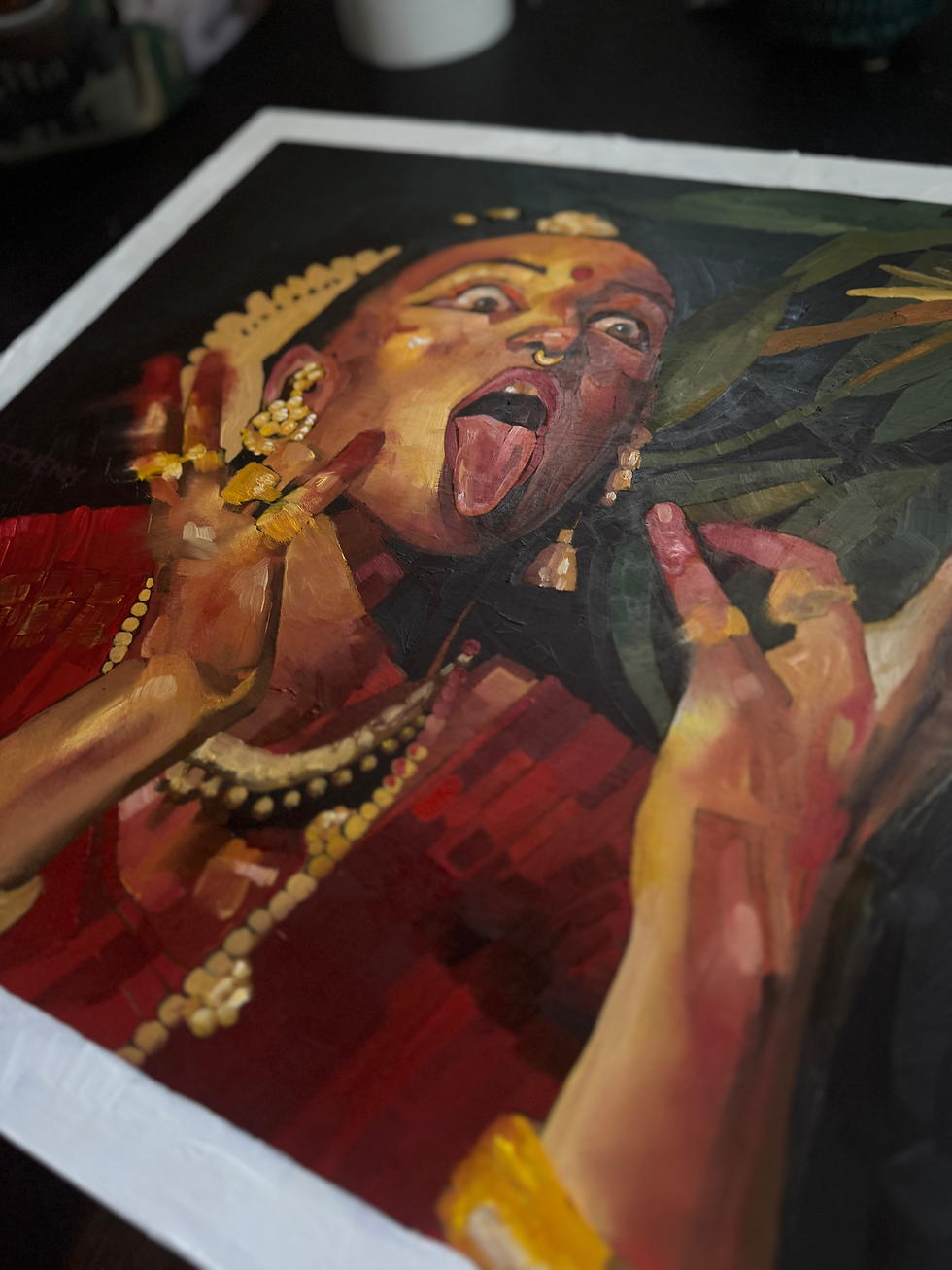
DGL It's such a fine line with all that. With AI sourcing from all kinds of photos everywhere, I'm sure there will be cases that are brought up in the future. You can imagine, there are people who feel they're being depicted in a painting. Maybe AI was sourcing something from their Facebook profile to create some kind of image. I think, what's the intention behind it? I think a lot of times, it's a big financial intention. I've looked at lots of different cases of image appropriation, and a lot of times it has to do with big companies and corporations getting hold of images and not doing their due diligence, not licensing the image. Then they put up these big campaign ads or end up on a billboard or something. Then they're profiting so much off that one image. We as artists, we're looking at the world around us. We need to get our inspiration from somewhere.


RS One of these is a painting of a photograph of Natalie Portman from V magazine. The reason that I painted this picture is that I truly love it, have loved it for years, and I couldn't bring myself to alter it that much. I flipped it, but I couldn't even take this winged, smoky eye away. I didn't even have the discipline to change it enough to do that. Because the thing is, it's Natalie Portman in a photo that only a handful of 45 year old gay dudes think about every single day.
DGL Like, that fantasy.
RS You might have this kind of photographic memory. I have this- like, gay men have obsessive memories for particular images, but the thing is nobody that's seen this, and it must have been at least 20 people in real life and no one has clocked that it’s Natalie Portman.
DGL Oh, wow, that's funny.


RS Nobody's trying to catch (intellectual property) theft, and so what if they did? Go to Wynwood. How many paintings of that one picture of Marilyn Monroe? Straight on, who's that photographer that shot her with big blonde hair and she's chewing bubble gum?
DGL I know exactly the image you're talking about and I know that photoshoot you're talking about.
RS Is that okay to copy? Because we just love to abuse Marilyn that way? Is it just the amount of time that's gone by? Is that why it's okay to make fine arts after some fashion photographers work? Now I'm getting a little emotional about it, just because it feels so misogynistic to me to just randomly pick four or five women to say, this person is worth painting badly. I guess it's because it is so straight.
DGL Yeah, it's the objectification of certain people and beauty standards, it becomes bigger than itself. With Marilyn Monroe, how much of an icon she is, people's obsession with her, even after she passed. Artists find so many different ways to approach their subjects, whether it's representing something about their lives or themselves they're connecting to. There's several portraits of Natalie Portman that I love. I've actually done photo shoots inspired by a maternity photo shoot she did with Annie Leibovitz. Gorgeous, timeless, black and white photos, she's just kind of like draping some fabric. It's not a big production.
RS That's great.
DGL Yeah, I get obsessed with a photo. Like, I need to recreate that, and then you kind of get it out of your system.
I remember doing that. I saw that image. It was an image that stuck in my mind. And then, maybe this past year, I had a maternity photo shoot and I was like, are you game to do this? And they're like, absolutely. We were inspired by that image. I usually have a mood board with me while shooting, trying to capture the energy, vibes, certain emotions that image is embodying. But I always like to try to make it my own.
I remember in college, we literally had assignments where we just had to do tear sheets, and we had to recreate an image to a T and I was like, oh, my god, I'm pulling my hair out. This is so frustrating to try to match up everything so specifically and some people are really good at that. It sounds like you're probably really good at it, you can see all those details and you can spend the time trying to match them. I can only do that to a certain extent.

RS I might be able to do it, but I'm looking at this wall and all these paintings look the same. Maybe I've been doing this long enough that my style is baked in. I painted Dustin. I just started work on a picture of our dog. The thing is that I can't paint Dustin over and over and over again, cause I'm not trying to keep these paintings for myself. I would like to sell them. And how many people want a picture of my boyfriend? I don't know, maybe a few people…
DGL Everyone in Lifetime. He does know everyone.
RS He is very popular. He does introduce everyone.
DGL Just do an art show of Dustins and invite everyone he knows.
RS There's a million examples of that, Mucha used the same model over and over. Manet. There's a history of artists and their Muses.This couple I was just out with, they were like, oh, I really like your paintings. I would love to get a painting from you. And I'm like, your kid is cute. I have to paint a kid, show people that I can paint kids portraits and they happen to have a son and I like them. So I go, maybe I can cut you a deal on doing something like a portrait of your kid. I'm doing a dog so that I can show people that I can do dogs… is that commercial art? That is what I did with my entire tattoo career. Reeks of desperation, right? If I say, I'll do a free painting of this kid, paint my dog so that I can show you that I can paint your dog and your kids, so you give me money.
DGL It’s very transactional.
RS But is that fine? I think that's fine. Is it smart? Who knows?

DGL There's no handbook on it. You know, it's a very abstract road and journey to find whatever you need to find as an artist, what makes you personally feel successful. I went to this talk at the museum about a week ago. And I'm not gonna mention the artist's name, but it's an artist that I've been following for a while. When I first saw his work, it was extremely edgy and really cool and very unusual. And he was having this talk at the museum to basically fund-raise to have the museum acquire one of his pieces, because I'm sure one of his pieces now are probably like, you know, fifty, seventy-thousand. It was a sculpture, and it was a cube with a flower on it, but like a two dimensional flower. so it was very minimal compared to the work I really remember seeing him create. And he was talking about, “oh, in my 20s, I was doing work that looked like it was made by a 20 year old.” And I was like, I like that work that you were making as a 20 year old, what happened? You know, he's figured out another component to the art world, which is profiting off your work. And that's okay. It's not bad to say, hey, I see value in my work. I wanna profit off of my skills. I've faced struggle in that as well, I have a commercial photography business. I do head shots, portraits, maternity stuff, actor head shots- that's a very commercial thing. Then I have fine art portraits, which are very different. I have struggled trying to find that nuanced balance between having a set price which I charge for photo shoots.
Sometimes you need, for your fine art, to make some sacrifices. I do need this for my portfolio. Let's do a trade. I still do that, for my fine arts stuff. If I have an idea, usually I have to pay to get it made, I have to pay a hair and makeup person, I have to pay to get a set together that I want. So it ends up costing money to produce work. The payoff is you sell pieces. For me and how I want to navigate the art world, I don't want to have to rely on the sale of my artwork to create my art. I think that puts you in the position of making art only to sell it. And then you're putting so much pressure on yourself. It's very hard to sell art. It's not the easiest thing. There's balance between that. It depends on you as an artist. What you want for yourself.
RS You're right. It's not like I hate this picture of my dog. I do enjoy painting pictures of dogs. I'm sure you enjoy taking pictures of the actors.
DGL I will stage a set with my cats, I have a light on them, I do the whole shebang, I love it too. I think it's important for us to not focus on what these limitations are. Society likes to categorize artists. I think that's changed so much, with social media, artists have taken control and power over their art and their narratives and being able to present it, to put it out there, whereas we had to rely on galleries to do that before. But now, given the state of the gallery world, I don't want to say it’s a dying world because it's still alive and happening, but galleries are really struggling to keep the doors open, it's not the only place to see and to buy artwork now.

RS Sure, the more I do online, the more I remember in interactions in real life to mention that I do art. I don't know about you, but when I meet somebody, I'm not immediately like, oh, maybe this person is the one that's going to fall in love with this painting that I did and buy.
DGL We put a lot of pressure on ourselves as creatives and artists and how we find that value and that worth in ourselves to keep it going, to keep that creative fuel alive. In that conversation we had about you and your tattoo career and the struggle of getting people to pay you fairly for your work, and you're a very talented tattoo artist, in the Miami market being different from the Texas market. Having to continually find that fuel that drives us as creatives is half the battle. It's so cliche, but you do have to find it in yourself. No one else is gonna be able to really give it to you. I know this is just who I am.
This is who I am. This is what I do. I'm here to make art. I'm here to speak this language that I know.

RS My sister said people she meets are perpetually unimpressed with fiber arts. Do you feel like photography is “othered”? In talks with non-artists, artists, the art community, How do you see photography is treated differently from painting or sculpture?
DGL Oh, like one hundred per cent, it's treated differently. I mean, there's so many calls for entries that I look at. And they always say ‘no photography entries’.
RS Oh my god, ‘no fats, no femmes, no asians’. So fucked up.
DGL Photography has always kind of been looked at in a different way, like even when it was introduced in the 1800s, painters were very afraid of photography because they thought it was going to completely eradicate their medium. Now we have this technology that can capture something identically and painters for the longest time were just trying to capture realism and hyper-realism. And then it kind of shifted and changed painting and the way painting was even being approached, because all of a sudden now we actually can achieve hyper-realism. Photography is a tech medium, so it continually evolves based on the technology. Now, it's getting into the AI world with how people are experiencing photography. So photography is definitely looked at differently, it's also not as much of a tactile medium anymore. It's not like you're developing in the darkroom. That's how I started, so I have a lot of experience with that, and I love it, but it's very cumbersome. I love sculpture, I love painting and I think those are kind of like the pinnacles of art. I value and respect that about painting and sculptures. It's like the OG.

RS One thing that I think about on a daily basis is that every painting that you ever saw before, certainly before 1900, these people were making their own paints, they weren't going and buying any of this stuff. I'm so loyal to the company that I know, I won't even use different brands. Because I love the textures that I'm used to in certain colors. You weren't getting your linseed oil from the same manufacturer reliably 300 years ago.
DGL …in the market and probably pick up some linseed oil and some pigments, you might have to crush down the pigments yourself and then mix it.
RS Just rocks and oil and plants. It's all just the earth.
Meanwhile, all the musicians that possibly read this will be like “what? Hi...” You know, all the writers and the poets are screaming.
DGL We respect you all too. You're definitely the OG of art as well. Art is a very fluid medium, but in my experience, paintings and sculptures in museum settings, in gallery settings, just hold a different value. And maybe it's just because people see the hand of the artist more directly through those types of applications. Photography is a very two dimensional medium, you're producing something where you see the hand of the artist, but in a much different way.
RS I was at the Lowe art museum the other day, and I must say whenever you're at a place that's well funded and small, I tend to get really into the quality they keep their pieces in, because these paintings were CLEAN. These paintings, you could see yourself in these three, four, five hundred year old paintings and I'm like who is cleaning these things on a daily basis? For me, I go and I look at a painting of something weird like a topless saint or something. I could care less about the content but this piece of wood with this piece of rock ground up on it, It's still there. It's just like a perfect presentation of some ground up rock. I love beautiful ground up rocks.

DGL I love that description. Just some ground up rocks thrown at a canvas.
RS I must tell you one of the best things that ever happened to me in my life. I had this meditative, contemplative walk during COVID lockdown. I had been walking, at this point…I was in Deep Ellum, which was like 7 miles from my house. So I had been walking for a while at this time, and I was thinking about science fiction and fantasy. I was letting my brain go, I was listening to Kasey Musgraves of all things. I remember this so clearly. And I was thinking of, like, a witch in a fantasy novel, like throwing a bunch of ingredients into a cauldron, summoning a face and talking to it. Right? And I'm like “Bitch, that's Facetime”. You synthesize materials of the earth to communicate with somebody far away, its fantasy. It's all just a matter of time. Right? Whenever silicon chips and film or like, recorded music was a new idea, that's still made from the earth. These things are not from the moon and we managed to make it so when i'm over here being like, oh, I don't even fuck with acrylic paint. It's like, plastic is still on the earth.
DGL I mean… the way materials are composed and made now. It's incredible what we have access to, but we also become very picky because we have so many options now. Back in the day, painters were probably just happy to get their hands on blue… You know, like praise the lord!
RS OMG. Have you heard of blue?
DGL The blue color is fabulous. Like red, oh, my god, you gotta get your hands on red. Now there's so many options and choices and different types of paints, in the way we’re applying the paints. We're living in an era of abundance, it's incredible what we can create from that.

RS You're 39. So you became creative during the time when photos were at the worst that photos have been in the history of photos, like Target developed, 3×5, disposable cameras. That's the worst format, the worst paper, the worst aesthetic.
DGL Yeah, it's interesting, kinda true.

RS Maybe some gen alpha kids will make that aesthetic look cool with like, Kikwear jeans photo shoots, but like…
DGL They already are
RS Sort of. The thing is that they're not making it on like, a thrift store camera and getting it developed at a Target, though. They're doing it in after effects, so that's not the same. When I think about photos that I have of my friends from high school, not a single one of them is good, as a photo, as art. But when you look at photos that my parents took on their honeymoon, just by virtue of the format of it, this square with the white border, and the beautiful paper that it's printed on. Even bad pictures looked good. We had good pictures that looked bad.
DGL That goes back to the value of photography. Back then, you didn't have the ability to take something on your phone and just save it in your archive. If you want to print it out, you can, but really it just remains in your phone. Photos back then were more valuable and rare because they were printed with silver halide. So literally using materials of the earth, silver, to create photos and that gave film prints such a more luscious, beautiful quality and aesthetic to them. So even when you're looking at, like you said, a crappy photo from the 90s or whatever, it still has a different feel to it than now, when we're (rarely) printing out photos.
I've noticed this, especially with the younger generations. They're using those materials more now, especially in fine arts settings, because I think it's going back to that tactile feeling of photos, because it's so sterile. It's nice. I'm here for it. It's never gonna be like what we did, but you all have fun with it.
"...there were a lot of queer people that were coming down here, using Florida as their kind of playground."

RS You speak about queer symbolism in your recent show, including underground symbols and dog whistles to signal queerness. How have these symbols evolved over time? Is there anything like that today?
DGL Yeah, you know, it was an interesting kind of thinking. Symbols of the past like green carnation flowers that were utilized in a way that's been very documented. There's lots of documentation of that specific kind of symbol. I don't know if i'd say a dog whistle, that seems a little..
RS I guess I was thinking like, hanky code when I wrote dog whistle, which is,
DGL yeah, when i hear dog whistle I'm like, oh my god, you're dangling the red meat for the republicans to come…actually, maybe that is what I'm trying to do. I don't know. I wanted to use things that were somewhat broad and ambiguous. In history, there are lots of references, lavender flowers, pansy flowers, which is kind of where that term ‘pansy’ came from, being a ‘pansy’. So when you see certain symbols used in paintings, photos, different types of artwork, even back in ancient Greece, like the way that they would use symbols on pots- two males together, two females together. I mean, it's things that we can't necessarily 100% pinpoint and be like, yes, this person was gay or whatnot. There's a lot of discoveries that we have to make as a society to piece those things together, because we had to use quote unquote, hanky code, to communicate with one another. In modern day terms, I think there's obvious things, like pride flags, and that's kind of too obvious.


RS And it’s not soigné. Maybe if you were in charge of picking the dyes... Because if you made a rainbow flag from your work, from those colors, I would put that flag outside the house.

DGL I wanted to avoid that, but looking at the body of work as a whole, there are those colors and I imagine seeing them all coming together gives us the feeling of a rainbow, without it just knocking one over the head. The flamboyance of nature for me, there's so much symbolism in butterflies. Everyone relates to (butterflies), not just the queer community, but I was pinpointing in the show the idea of coming out. Coming out of the closet, emerging out of the cocoon. That kind of symbolism, at least how that relates to me as a gay male, because I've gone through that experience, every queer person has to go through that very brave experience. I don't think we give enough credit to people just having to announce themselves, like coming out and saying, “This is just who I am. Deal with it”. I was trying to find references in symbols that haven't even really been completely accepted yet, with weight and value to it, either through things that I've seen used in queer art or things that align with those ideas.
RS I love that. As a tattooer, when anybody tries to reach for a bad example, or passe, or basic bitch tattoo, they always say butterfly. Which is so rude, because the butterfly is the best thing in the world. It's beautiful. It has built in symbolism. It has color, or not. It has texture and pattern, or not. It has everything. It has different great angles, it has symmetry, or not. I’d point this out and then people would say, oh, but I have to be different. And then they would say I want a moth. And I would say, a moth is a shadow side of a butterfly, but aesthetically, it's clunky, it's too busy, it's muddy.
A butterfly is so declarative in their markings, almost always. One side is usually clearer than the other of the wings. With a moth, sometimes you get these patterns that look like 70's sofas that are insanely beautiful. But moths are also made to blend into their surroundings, they're not made to stand out like butterflies are. And I'm like those moths are straight people. And butterflies- that's gay people. We stay up all night. We are like that about moths!

DGL Yeah, we do. I'm telling you that sometimes I'm up til five in the morning. My sleep schedule has changed. I'm becoming a night owl, and it's like my creative times. It shifts and changes a lot.
Butterflies are very cliche. I'm very aware of the fact that it's a cliche symbol, not just in art, but in general, it's very overused. I also think there's something about that, which makes it very good as a connecting agent.
RS Absolutely, but so is a rainbow and a person's face and the sun.
DGL I like using ideas and materials that everyone can relate to. It doesn't matter if you're gay or straight. I like trying to create things that anyone can enter into that world. Everyone can have some connection, the idea of a metamorphosis, change, rebirth. Those are themes that we constantly go through. And if you're not going through those, I don't know what you're doing, because as we grow, we evolve, and we change. We all have those kinds of connections.
RS If we’re lucky.
DGL If we’re lucky, that is very true. If we're lucky, hopefully we get those changes.

RS Additionally, when a butterfly enters your field of vision, it is like a little unexpected party, because the way that they move and their color wasn't there a minute ago, and they just like, bless you with color for a moment from the side of your eye. I don't think about people entering my field of vision the way that I do butterflies bopping in.
DGL Fluttering by, bopping in. In the images from that recent series, those were butterflies that I hatch from cocoons. I go back and forth having butterfly gardens. I don't have the best green thumb. Leading up to that show, I had a little butterfly garden, that's how I was able to get the butterflies to interact with my subjects. They start as a caterpillar, they go to the chrysalis, and when they emerge from their chrysalis, they don't realize they have their wings yet. So you can actually hold them. They'll stay on your finger, you can place them anywhere. It's not until they get that first gust of wind, they realize, oh shit, I have these things on me that allow me to fly. love that metaphor in itself, too. You know, having those wings, they're not realizing they have the ability to use them and the power that exists when we realize, I've had this the whole time. I can use this power that I have. I've always connected with the symbolism of butterflies throughout different phases of my life. I kind of feel like I'm in that moment, having emerged out of the chrysalis, having explored, having no reach of the next level, and now, using those wings as a means of power, getting to see perspectives of the world that you can only reach with wings in that new way you can see the world. And so that's where I think I was trying to explain butterflies in the show. I tried to show them as symbols of power, specifically for queerness. The power that we as queer people really have. I think we're at a moment in history where we really have to show our power because we are being legislated against. We are being discriminated against much more. It's at our front doorstep here in Florida.

RS100% agree with that. Speaking of Florida, you have this incredible collection of Florida photographs. And during our talk, you mentioned how you're not from here, but that you really like…Well, I don't want to put words in your mouth. You like Florida. You're interested in the history of Florida…
DGL I love Florida.

RS In your exploration and research of queerness in south Florida, have you discovered any inspiring people or places that people may not know about? Any can't miss stories? I think of Before Night Falls, by Rinaldo Areinas. I don't know if you’ve read that book.
DGL I haven't, but now you're putting me on to it.
RS It's about Cuba. But I think that in the end, he ends up in Miami. I would love to have a conversation about that book because when I read that, I think I was a little self-hating. I was out and had been out forever. When I read that, I had a boyfriend that is now a MAGA talking head on FOX news. He wasn't at the time. He was liberal but we were both drunks. He had me read that book, this memoir is about a gay Cuban, the 60s, 70s, whatever, he was constantly getting locked up for being a slut. Everybody in his life was like, I don't know why you can't just be a little bit less, they're not gonna arrest you if you just have sex with one dude and don't talk about it all the time. And he's like, that's not me. And so he spent forever in a terrible Cuban prison and stuff. And then, he escapes. And I think he came to Miami, but I was kind of on the side of ‘those gays’ when I read it in like 2013. 2013, which seemed like such a progressive time, like a perfect time to be alive. 2014 is the year that I remember as being like, this is the most progressive, this is the best its ever gonna get- gay marriage, yay! Now, I think I was also homophobic towards this person's memoir. When I read it, I didn't know anything about Cuba. I don't know anything about Florida. And I still don't know anything about queer Florida. So maybe you could tell me a thing or two.

DGL I've been reading this book. It's called Welcome to Fairyland. And ‘Fairyland’ was Florida's kind of, tagline. Florida marketed itself as being this playground for sexual deviants. And health and wellness retreats. And so inevitably, there were a lot of queer people that were coming down here, using Florida as their kind of playground.
One of the things that I found really interesting in my research is the Vizcaya Museum and Gardens. That place is so queer. Have you been there?

RS No, but I know John Singer Sargent fell in love with it.
DGL Yeah, he painted a lot there. So he's another person that I've been looking at because he visited Florida a lot, and painted here a lot. And his work is very suggestive, he never came out and said that he was gay, but there's a lot of suggestion.
RS I started reading a book recently about him and that, but it was a little too academic and it didn't hold my interest.
DGL Yeah, sometimes those, it's tough for me too. But he painted at Vizcaya a lot. Vizcaya was created by James Deering and this artistic director whose name is Paul Chalfin, and Paul Chalfin was openly gay in the early 1900s, like 1910. He was pretty much the person who put together all the visual components of Vizcaya. It's a gorgeous museum-house. I highly recommend going to check it out. It has influences from all over the world. You know, like the architecture is… It's a little bit of French baroque, it's a little bit of Spanish. It has these beautiful, almost Versailles-esque gardens. It's right on the water. It's really something else.

RS Well, we have a Cheesecake Factory right up the street, so I don't know if I need to see that.
DGL That actually checks off all the boxes. That's fair. That was probably made by a gay guy.
RS I'm so sorry, that was such a cheap joke.
DGL I learned that the artistic director there was gay. I started walking around, I was like, oh my god, there's so much symbolism here, like sea horses. He put seahorse motifs all around, because it's a queer code, the male seahorse is the only species in the animal kingdom except sea dragons, which are pretty much the same, those are the only ones that the males give birth.
RS Go off, queen.
DGL Vizcaya also was a place where they would host white parties throughout the 90s. Maybe they started in the 80s. I think it ended in the early 2010s. And these white parties were big gay functions to raise money for research for AIDS. These parties would draw international people, like Madonna went to one of these parties at one point, and so a lot of funding for AIDS research actually came from these white parties that would happen at Vizcaya.
RS No way.
DGL Yes, bitch, that place is so queer coded, and has a queer history instilled there.
That was this little lighthouse beacon for me. And I've been trying to show there. I was a finalist for the contemporary arts program. They take proposals from local artists to interpret Vizcaya into different works of art. You get to display your artwork in Vizcaya. I think it's usually up there for about half a year.
My proposal was to explore the queer history there. There's so much. And I talked to the curator and she's telling me, we loved your proposal. It's a really cool idea. But then she said, I don't know if this is the right time to do this, or it could be the best time to do this just because of everything happening in Florida in regards to queer rights. Because Vizcaya is funded by the city. And Miami is conservative. Despite it feeling liberal, very open, it still has a conservative mayor. I didn't get that gig, but it also made me realize that Florida does have a lot of queer history imbued in it.
We have this really cool opportunity to explore and engage with that history to really bring it to life, because it's been covered up. You know, people don't realize.
Vizcaya Museum and Gardens.. Go check it out.

RS It's been on the list. I've been to Fairchild, the zoo, and I've been to Perez. I've kind of been saving Vizcaya. So Dustin and I can go together, but you know, work.
DGL Sometimes I just go. They have art-making events. They have tours, and they have night walks or stuff like that. They do a lot of programming there. That's a cool place to check out.
RS I think that's great.
DGL Well, thanks for thinking of me for this. I'm glad to indulge in conversation with you and just talk about the arts. I'm always here for that.

David is available for photographic projects, including portrait sessions, artwork documentation, and has work for sale at davidgarylloyd.com
You can also follow David on instagram @davidgarylloyd
This conversation has been edited for length and clarity.

Comments